Following a ceramic product through the thermal processing journey
Every ceramic component begins as a collection of raw materials.
1. At this stage, the final product may exist only as a specification: a required geometry, density, strength, thermal response, or level of performance in service. Achieving that outcome depends on more than selecting the right ingredients. Every stage of the manufacturing journey can influence the behaviour of the finished component.
2. The raw materials must be prepared. The formulation must be processed and formed. Moisture must be removed. The component must then be fired under conditions that allow its microstructure and properties to develop without introducing unacceptable distortion, cracking, variation, or other defects. Of all these stages, firing can be one of the most influential and least visible.
3. Once the ceramic enters the furnace, temperature, atmosphere, heating rate, heat transfer, loading arrangement, and its position within the firing space can all affect the outcome. The component that emerges may look complete, but its journey through the furnace will have helped determine how it performs. Lucideon and The AMRICC Centre help manufacturers understand that journey.

The journey begins with the raw materials
Our ceramic begins as a combination of powders, minerals, additives, or other constituent materials selected to deliver a particular set of properties. Before firing is considered, the materials and formulation must be understood. Differences in particle size, composition, distribution, moisture content, or processing behaviour can affect how the material forms, dries, densifies, and responds to heat.
Through Lucideon’s facilities and wider materials expertise, raw materials can be processed, evaluated, and prepared as part of a connected development programme. The objective is not simply to produce a formulation, but to understand how the characteristics of the starting materials may influence every subsequent stage.
This provides the starting point for the ceramic piece's journey and the baseline against which later changes can be assessed.
Creating the ceramic piece
The prepared material must now be transformed into a shape.
Depending on the product and process, forming conditions can influence density distribution, dimensional consistency, internal stresses, and the presence of defects. Some of these effects may not become apparent until the ceramic piece is dried or fired.
A variation introduced during forming can therefore reappear later as distortion, cracking, non-uniform shrinkage, or inconsistent material properties.
By connecting raw-material processing, forming, thermal processing, and characterisation within one development route, potential interactions between these stages can be investigated. This helps avoid treating a firing problem purely as a furnace problem when its origins may lie earlier in the manufacturing process.
The ceramic piece is then dried and prepared for the stage in which its final microstructure and properties will begin to develop.
Entering the furnace
Firing is not simply a matter of reaching a target temperature.
As the ceramic piece heats, a sequence of physical and chemical changes can take place. Moisture and volatile constituents may be removed. Binders may burn out. Phases may develop or transform. Particles begin to bond, pores change, and the component may shrink as densification progresses.
How these changes occur depends upon the conditions experienced by the ceramic piece throughout the firing cycle.
The furnace temperature may be controlled, but the component does not necessarily experience heat in the same way at every point. Its size, geometry, position, surrounding load, and proximity to the heat source can influence the rate and uniformity with which it heats.
These effects become increasingly important when moving from a small laboratory specimen to a large component or a representative production batch.
Lucideon’s Telemetric Furnaces offering provides the controlled processing environments, monitoring, and technical interpretation needed to investigate what happens during this critical stage.
Selecting the firing environment
The most appropriate furnace is selected according to the component, material, processing challenge, and required development outcome. For some ceramic pieces, the objective may be to optimise an existing gas-fired process. For others, it may be to assess electric firing, investigate the behaviour of a larger component, or explore hydrogen as an alternative fuel.
The Telemetric Dual Fuel Furnace allows the ceramic piece to be fired using either gas at temperatures up to 1700°C or electric power at temperatures up to 1600°C. Advanced monitoring, continuous process data collection, and mass measurement provide greater visibility of the firing cycle and the changes taking place within it.
This allows the development team to investigate factors such as:
- Temperature distribution
- Heat-source selection
- Heat flow
- Furnace atmosphere
- Firing schedule
- Component position
- Loading configuration
- Changes in mass during firing
Rather than assessing the outcome of the firing cycle in isolation, these process conditions can be recorded and considered alongside the properties of the fired component.
Understanding the effect of scale
Our ceramic piece may begin as a small laboratory specimen, but the intended product could be much larger. Increasing the dimensions of a component changes the way heat travels through it. The surface and centre may heat at different rates, temperature gradients may develop, and dimensional changes may not occur uniformly. A firing cycle that succeeds at laboratory scale may therefore produce a different result when applied to a full-size component.
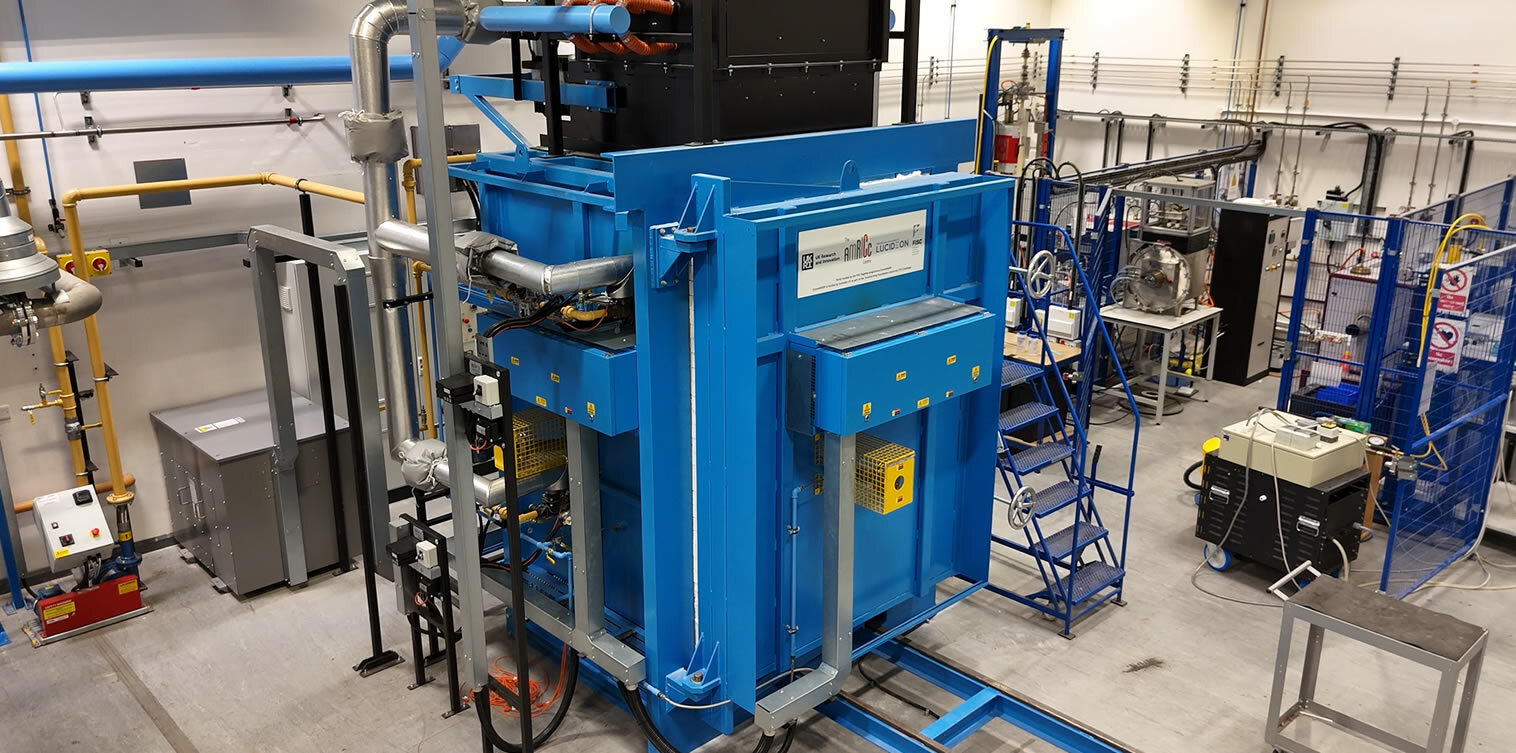
The Extra-wide Electric Furnace provides a 2.5m × 2m × 1m hot zone and operates at temperatures up to 1200°C. It offers thermal uniformity of less than ±5°C across the hot zone and has viewing portals that support digital data collection and in-process monitoring.
This makes it possible to follow the journey of a much larger ceramic or composite component, or to investigate a representative batch arrangement rather than an individual laboratory sample. The furnace can also be used as a high-temperature experimental test bed. A component or structure can be heated under controlled conditions while thermally induced distortion, dimensional change, or other aspects of high-temperature behaviour are investigated.
Exploring a lower-carbon firing route
The ceramic piece may also need to make its journey through a different furnace atmosphere. Manufacturers considering hydrogen firing must determine whether changing the fuel affects more than energy consumption. A hydrogen-based atmosphere may influence the behaviour of the material, the firing process, emissions, and the properties of the resulting component.
Our Hydrogen-Fired Batch Kiln enables thermal processing using hydrogen and hydrogen / gas mixtures. It operates at temperatures up to 1750°C and can fire with up to 100% hydrogen. Flue-gas analysis allows NOx, SOx, and water vapour to be monitored under different gas mixtures.
Our ceramic piece can therefore be fired under controlled hydrogen-based conditions before the resulting material is tested and compared with components produced using conventional firing routes. This creates an evidence-led route for evaluating hydrogen firing, helping manufacturers understand its implications for both the process and the product before considering changes at production scale.

Emerging from the furnace
At the end of the firing cycle, the ceramic piece emerges from the furnace. It may now have the required appearance and dimensions, but important questions remain:
- Has the required density been achieved?
- Is the microstructure uniform?
- Has the component shrunk or distorted as expected?
- Are its mechanical and thermal properties suitable for the intended application?
- Is there variation between different areas of the component or between components within the batch?
- Has the firing atmosphere affected the material?
- Can the results be reproduced consistently?
Answering these questions requires the furnace data to relate to evidence from the fired material. Lucideon’s testing and characterisation capabilities can be used to examine changes in microstructure, density, dimensions, thermal response, mechanical performance, and other relevant properties. Supporting techniques can include microstructural analysis, thermal analysis, high-temperature performance testing, Hot Stage XRD, FEG-SEM, and dilatometry. The result is a connected picture of the ceramic piece’s journey, from its starting materials and processing history to its experience within the furnace and its final properties.

Connecting processing to performance
A successful furnace trial demonstrates that a process can produce a particular result. A more valuable development programme explains why that result occurred. Processing and monitoring data from the furnace can be compared with measurements taken from the fired ceramic piece. This allows relationships to be explored between the firing conditions and the resulting microstructure, density, dimensional stability, thermal behaviour, or mechanical properties.
For example, the investigation might show how component position influenced temperature exposure, how a change in heating rate affected distortion, or how a different firing atmosphere altered the resulting material. The objective is to identify the process variables that matter and establish a firing window capable of delivering the required product consistently.
Taking the next step towards manufacture
The ceramic piece has now completed its development journey, but the wider manufacturing journey may only be beginning. The knowledge generated during the programme can help manufacturers refine firing schedules, evaluate alternative heat sources, understand scale-dependent behaviour, improve process consistency, and make more informed decisions about production scale-up.
Lucideon can connect raw-material processing, forming, thermal processing, computational analysis, testing, and characterisation, so the component does not pass through a series of disconnected activities. It follows one coordinated route. At every stage, information from the material and process can be used to inform the next development decision.
Adding IMPACT™ to the journey
For complex materials and processes, the relationship between furnace conditions and final performance may involve many interacting variables. IMPACT™ adds computational analysis to the development journey. It combines first-principles guidance, finite element analysis, machine learning, and computational materials engineering with experimental materials science.
For a Telemetric Furnaces programme, IMPACT™ can help interpret the data generated during processing and testing. It can be used to explore relationships between process variables and material response, support the refinement of experimental programmes, and help identify the conditions most likely to deliver the required outcome. The physical ceramic piece provides experimental evidence. Computational analysis helps extract greater value from that evidence.
Together, they create an iterative development route:
1. Define the properties required from the ceramic component
2. Understand and prepare the raw materials
3. Process and form the component
4. Dry and prepare it for firing
5. Select the appropriate furnace, atmosphere, and monitoring approach
6. Fire the component under controlled conditions
7. Collect and interpret the process data
8. Test and characterise the fired component
9. Connect the process conditions with the final material properties
10. Refine and validate the preferred processing route
Each iteration adds to the understanding of how the component behaves and what must be controlled to produce it successfully.
From raw material to understood product

Component performance
A ceramic component's performance is the result of its complete manufacturing history. The raw materials establish its potential. Processing and forming create its structure. Firing develops its final microstructure and properties. Testing reveals what has been achieved. Computational analysis helps explain why.

The furnaces
Lucideon's Telemetric Furnaces offering brings these elements together, providing more than access to high-temperature equipment. It makes the furnace part of a connected, data-led materials development journey.

Objectives
Whether the objective is to optimise sintering, investigate distortion, process a large component, evaluate hydrogen firing, or de-risk scale-up, we can follow the ceramic piece through the process and help turn each stage of its journey into useful evidence. The result is not simply a fired component, it is a better-understood material, a more clearly defined process, and a more confident route towards manufacture.
Our experts
Discover more about our experts.


Read our other stories
Enabling Net Zero
Leveraging our expertise to solve your Net Zero technology materials challenges

Read our other stories
intelligent Microbiology-Driven Formulation (iMDF)
Combining consultation with intelligent Microbiology-Driven Formulation development to make informed decisions

Read our other stories
Constructing a sustainable approach
Combining structural expertise and world-class testing facilities for advanced methods of construction

Read our other stories
Integrated Materials Processing and Computational Techniques (IMPACT™)
Combining our expertise and computational methods to solve your material and process development challenges

Read our other stories
Materials for Harsh Environments
Transcending the most demanding requirements with supreme performance qualities